Printed Signs or a Welcome at the Door?
Printed signs or a welcome at the door? See how clear directions and a low-pressure greeter help first-time visitors find rooms and ask for help.
Printed signs or a welcome at the door? For first-time visitors, printed signs work best for simple directions they can read at their own pace; a person is better for questions that depend on the situation. A community room usually needs both, but not as competing versions of the same instruction.
Printed sign basics
Signs should answer questions with stable, short answers: where the toilets are, which room hosts the meeting, whether coats can be left on a rack, or where to find drinking water. Place each sign near the point where someone needs that information. A direction beside the entrance is useful; the same direction hidden behind a stack of chairs is a small test of patience.
Use plain words and familiar landmarks. “Meeting room, through the blue door” gives a visitor more to act on than “Activities this way”. If the destination is not visible from the sign, add an arrow or name the next recognisable point. Keep text large enough to read from the place where someone must make a choice, and use strong contrast between lettering and background.
Signs also let people check information without having to ask. That can matter to someone who is shy, hard of hearing, arriving after a session has begun, or carrying a bag while keeping track of a child. Put essential information where it is easy to read and avoid relying on colour alone to distinguish destinations.
When greeters help
A greeter can respond to questions that a sign cannot settle: whether a visitor may join an activity already under way, which group is meeting in the side room, or what to do when the named room is occupied. A person can also notice hesitation and offer help without requiring a newcomer to guess which sign applies.
This is especially useful when the space has overlapping activities, temporary room changes or customs that are hard to explain in a sentence. A brief welcome can make the social invitation explicit: “You’re welcome to sit in; the organiser is near the window.” That tells someone not only where to go, but whether entering is appropriate.
A welcome should not become a gatekeeping interview. Visitors should not have to explain why they are there before receiving ordinary directions. Offer a clear greeting, name the person or activity they may be looking for, and leave room for the visitor to decline help.
Where signs fall short
Signs become unreliable when information changes faster than someone updates them. A handwritten note saying “meeting moved” may help, but only if it is placed where visitors will see it before following the old route. Conflicting notices create a second task: deciding which one to trust.
Some questions have no single answer. “Can I use this room?” might depend on whether a session is running, whether the room is reserved, or whether a staff member needs to unlock it. A sign saying “Room available” can mislead if it describes only the usual arrangement. Where the answer changes, name a person or contact point instead of trying to print every exception.
Signs can be missed because of glare, visual clutter, limited reading fluency or an unfamiliar symbol. They can also leave visitors uncertain about tone. “Please wait” might mean wait for a host, wait for a class to finish, or wait because entry is restricted. Add the next useful action, such as “Please wait here; a host will come to you.”
Where greeters fall short
A greeter cannot help someone who arrives when nobody is stationed at the entrance. They may be speaking with another visitor, setting up a room or away from the door. If essential directions exist only in conversation, late arrivals and people who prefer not to ask are left to improvise.
Personal help can also vary. One volunteer may know which group is meeting; another may be new to the space. A friendly answer that is confidently wrong sends a visitor in the wrong direction. Keep basic directions visible, and give greeters a simple way to check the current room schedule or contact the organiser.
Some people find an unexpected conversation harder than reading a notice. A welcome is most useful as an offer rather than a demand: “Hello. The room list is here, and I can point you in the right direction if you’d like.” The visitor can then choose whether to talk.
Pairing signs and people
Give signs the questions with predictable answers and give the greeter the questions that need judgement. The two methods should agree on room names and destinations. If a notice calls a space “Studio B” while the greeter calls it “the back room”, a newcomer has to decide whether those are the same place.
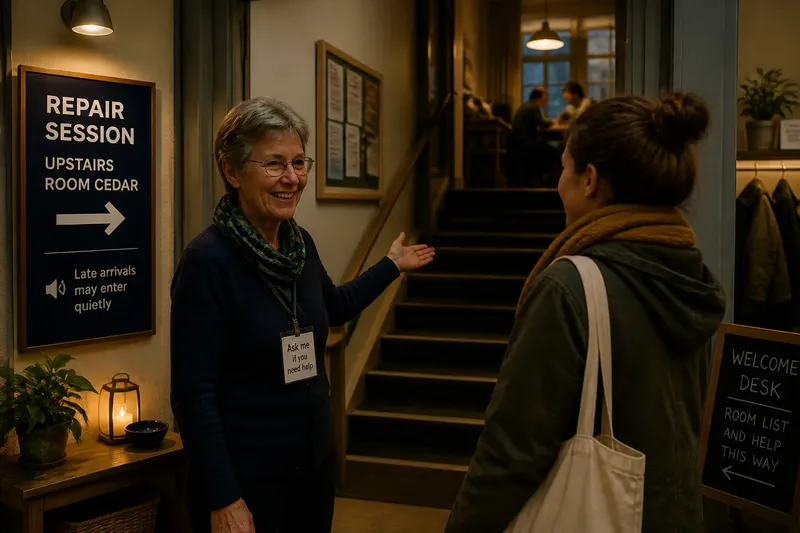
Imagine a first-time visitor arriving for a neighbourhood repair session. The entrance sign says “Repair session: upstairs, Room Cedar”, with an arrow and a note that late arrivals may enter quietly. A volunteer at the stair landing can answer the less predictable question: whether the organiser has space for an item that needs a particular tool. The sign handles arrival; the volunteer handles the case-specific decision.
Keep a short list of the questions visitors actually ask, then decide which have a stable answer and which need a person. A note in the room diary can reveal that several people keep asking where to leave pushchairs. If the answer is stable, put it where it is needed; if it depends on the day, make sure someone can answer it.
What should a first-time visitor expect?
A first-time visitor should be able to reach the right area without having to guess, and should know where to turn if the signs do not answer their question. That is a modest standard, not a promise that every uncertainty can be removed.
Make the first point of contact obvious. A clear sign can say “Welcome desk” or “Ask here”, while a greeter can stand where visitors naturally pause rather than behind a table covered in forms. If no one is available, provide a visible alternative, such as the session organiser’s name and where to find them.
Choosing signs or a welcome?
Are signs enough for a small community room?
They may be enough when there is one clear entrance, one regular activity and straightforward directions. Add a way to ask for help if the room is shared or its use changes during the day.
Should every visitor be greeted personally?
No. A visible, low-pressure welcome gives people the option of asking without requiring conversation. Some visitors want a quick direction; others would rather read and continue on their own.
What belongs on an entrance sign?
Include the names of the main destinations, a clear direction where needed, and the next action if entry is not immediate. Keep temporary changes separate and remove them once they no longer apply.
How can a team tell what remains unclear?
Notice repeated questions, pauses at the entrance and visitors heading towards the wrong door. If these occur, adjust the sign or make a greeter easier to find; adding another paragraph to every notice is rarely the answer.
For printed signs or a welcome at the door, the useful distinction is simple: print what stays true, and offer a person for what changes or needs interpretation. Check that the sign’s wording matches the room names people use, and that the person welcoming visitors knows where to find current information. That small agreement prevents a newcomer from receiving two polite but incompatible directions.